
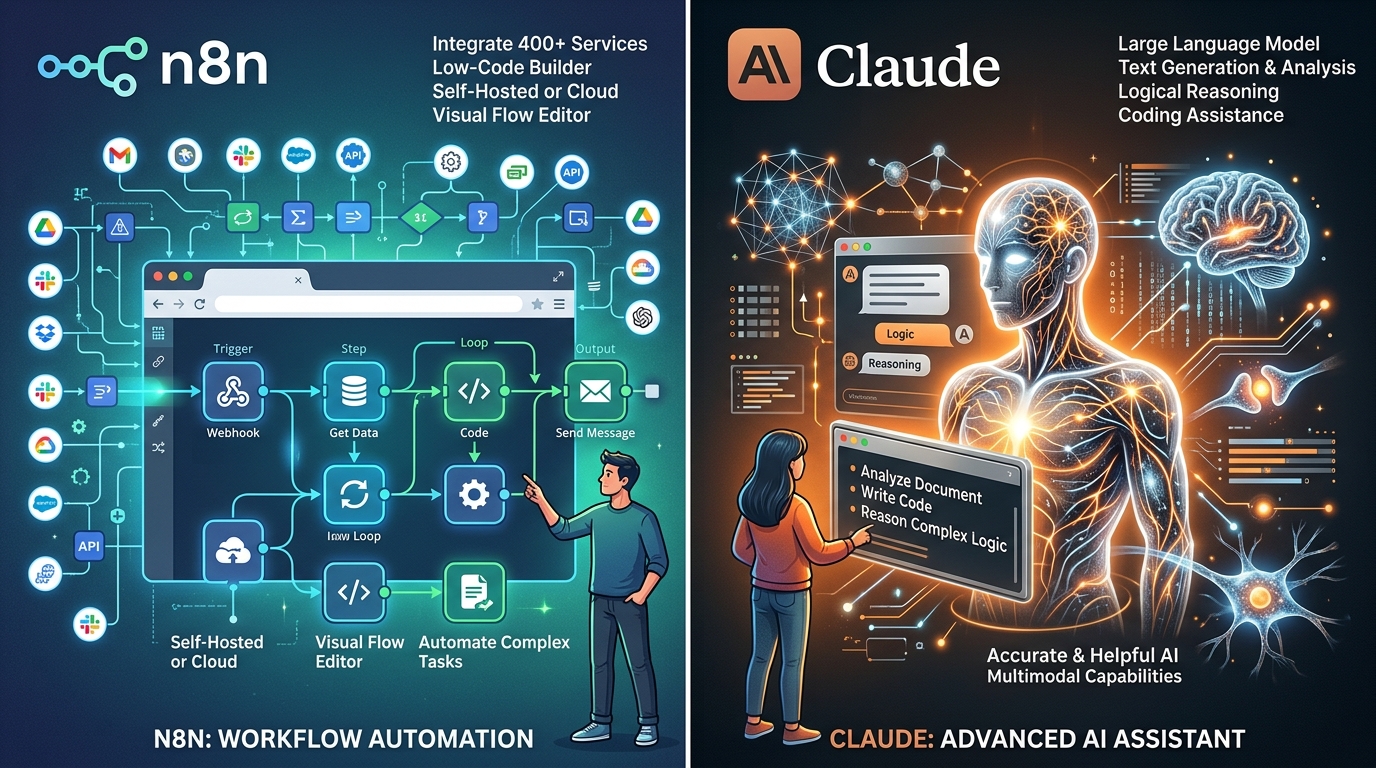

When evaluating modern automation and artificial intelligence platforms, comparing N8n vs Claude AI reveals two complementary pillars of the modern technology ecosystem. Understanding how an event-driven workflow engine differs from a frontier reasoning model helps developers and business leaders construct resilient, scalable automation architectures.
This comprehensive guide analyzes the structural differences, feature sets, integration mechanics, pricing tiers, and ideal deployment scenarios for both platforms. You will learn how to leverage each tool individually, identify key operational tradeoffs, and combine them to build intelligent, autonomous business systems.
N8n vs Claude AI: Core Architecture and Mental Models
Understanding the architectural division between N8n vs Claude AI begins with examining their underlying mental models. While both technologies are frequently grouped under the broad banner of modern tech stack optimization, they solve fundamentally different engineering challenges. One acts as the deterministic nervous system for data movement, while the other serves as a probabilistic cognitive engine capable of complex reasoning.
n8n is an event-driven node-based workflow builder designed to orchestrate data across APIs, databases, webhooks, and enterprise applications. It provides a visual canvas where every node represents a discrete, deterministic action—such as listening for an inbound HTTP request, parsing a JSON payload handling routine, querying a PostgreSQL database, or executing custom JavaScript and Python code. The mental model of n8n is centered around structured pipelines: given a specific input trigger, execute explicit conditional logic, retry failed requests, log state transitions, and deliver predictable outputs to external destinations.
Conversely, Claude AI—developed by Anthropic—is a state-of-the-art generative AI language model engineered for advanced reasoning, natural language understanding, nuanced text generation, complex coding, and strategic analysis. Claude does not natively maintain server infrastructure, manage cron schedules, or maintain persistent connections to external database endpoints on its own. Instead, it processes contextual prompts, interprets unstructured inputs, and returns probabilistic responses based on deep semantic comprehension.
Choosing between N8n vs Claude AI is rarely an either-or decision for sophisticated operations. Rather, it requires determining which system should own execution control and which should own cognitive processing. n8n excels as the operational runtime that manages state, authentication, and service connections, whereas Claude AI serves as the intelligent brain invoked during execution steps that require human-like judgment.
Key Features and Capability Analysis
Comparing N8n vs Claude AI across functional capabilities highlights how their feature design caters to distinct operational demands. To evaluate their suitability for your organization, consider how each platform handles execution control, integration breadth, data manipulation, and error recovery.
Workflow Orchestration and Execution Control
n8n is built specifically for workflow automation and system integration. Its visual canvas allows users to construct multi-branch workflows with explicit conditional paths (If/Else, Switch), iterative loops, waiting states, and error-handling sub-workflows. It tracks every execution instance in detail, allowing developers to inspect payload schemas at every step, replay failed executions, and enforce rate limits across third-party APIs.
Claude AI focuses entirely on cognitive processing, semantic analysis, and natural language tasks. Through the Anthropic Claude API or its conversational interfaces, Claude processes massive contextual windows—up to 200,000 tokens in standard models—enabling it to analyze lengthy legal contracts, parse large code repositories, or synthesize complex research reports in a single inference call. However, Claude lacks native workflow orchestration tools like visual execution histories, cron schedules, or built-in OAuth credential storage.
Integrations and Protocol Ecosystem
n8n offers over 400 pre-built native integrations alongside flexible HTTP Request nodes, enabling connection to virtually any REST, GraphQL, or gRPC endpoint. It functions as a powerful Zapier alternative for organizations seeking fine-grained control, cost efficiency, and non-linear logic pathways. Furthermore, n8n supports community nodes and custom node development using TypeScript, allowing engineering teams to extend its capabilities indefinitely.
Claude AI connects to external tools primarily through structured function calling and the emerging Model Context Protocol (MCP). While Claude can generate structured JSON tool calls indicating which API function should be invoked next, it relies on an external runtime—such as custom backend code, Claude Code CLI, or an n8n workflow engine—to execute the physical network request and return the result back to the model.
Data Processing: Structured vs. Unstructured
A primary distinction in the N8n vs Claude AI evaluation lies in data transformation mechanics. n8n shines when manipulating structured data objects (JSON, CSV, SQL queries) through precise code snippets, standard mapping functions, and explicit data schemas. It processes data deterministically with minimal computational overhead.
Claude AI excels at converting unstructured data into structured outputs. It can ingest raw text emails, scanned PDF invoices, unstructured customer support chats, or messy HTML pages, interpret their underlying intent, extract relevant entities, and output validated JSON objects ready for processing by traditional software applications.
Deep Dive: Deterministic Workflows vs. Probabilistic Intelligence
To build reliable enterprise software, architects must carefully separate deterministic processes from probabilistic functions. Mixing these paradigms without boundary controls leads to brittle automations or unpredictable software failures. Analyzing N8n vs Claude AI illustrates how these two computational models function in production.
Deterministic systems are predictable and repeatable. When n8n executes a workflow containing an HTTP node, a data transformation node, and a database insertion node, the exact same inputs will produce the exact same operational sequence every time. If an API endpoint returns a 500 status code, n8n follows configured retry policies or triggers a designated error branch. This reliability is vital for multi-step business processes like invoice processing, user provisioning, database synchronization, and transactional notifications.
Probabilistic systems operate on statistical likelihood. When Claude AI processes a prompt, it selects tokens based on context and statistical probability. This non-deterministic nature grants Claude impressive creative intelligence, language translation capability, contextual summarization, and adaptable problem-solving skills. However, relying purely on a probabilistic model to execute strict multi-system operations introduces risks of hallucination, missed steps, or unexpected formatting shifts.
| Feature Dimension | n8n Workflow Automation | Claude AI (Anthropic) |
| Primary Classification | Event-Driven Workflow Runtime | Large Language Model / Reasoning Engine |
| Execution Paradigm | Visual Node-Based Flowchart | Natural Language Ingestion & Prompting |
| Data Processing Type | Deterministic JSON/Array Operations | Probabilistic Natural Language & Code |
| System Integrations | 400+ Native Connectors & Custom APIs | Function Calling & Model Context Protocol |
| Deployment Options | Cloud Hosted or open-source self-hosting | API Access or Web / Desktop Applications |
| State & Retries | Persistent Storage, History & Retries | Stateless per Request (Requires External Context) |
| Ideal Operational Focus | Process Orchestration & Data Plumbing | Reasoning, Extraction & Content Generation |
By leveraging n8n as the outer deterministic wrapper and Claude AI as the inner probabilistic reasoning step, engineering teams establish robust guardrails. n8n handles the webhooks, authentication, and schema validation, while Claude processes complex logic, returning structured outputs back into the controlled n8n pipeline.
Developer Experience and Integration Mechanics
The developer experience when evaluating N8n vs Claude AI differs substantially depending on whether the primary goal is visual workflow construction or AI model integration. Both tools prioritize developer agility, but they approach user workflows from distinct angles.
n8n offers a hybrid experience bridging visual low-code development with full code flexibility. Developers can drag visual nodes onto the canvas while retaining the ability to write JavaScript or Python directly within Code nodes to perform complex data transformations. Workflows can be exported entirely as JSON documents, committed to version control systems like GitHub, and deployed across environments using CI/CD pipelines. Furthermore, n8n includes built-in LangChain integration nodes, enabling developers to visually construct AI agents, memory vector stores, and retrieval-augmented generation (RAG) pipelines without writing boilerplate framework code.
Integrating Claude AI into developer environments typically occurs through the official Anthropic SDKs (available for Python and TypeScript) or via direct REST API calls. Developers craft system instructions, manage conversation histories, tune sampling parameters (such as temperature and top-p), and implement structured output enforcement via JSON schemas. Advanced developers also utilize Claude Docs to implement prompt engineering best practices, such as chain-of-thought prompting, XML tag structuring, and few-shot contextual examples.
For developers seeking terminal-centric automation, Anthropic offers Claude Code, an agentic coding assistant that executes inside the local terminal. While Claude Code allows developers to refactor local repositories, run terminal commands, and create automated scripts, it operates at the developer workstation level rather than serving as a multi-tenant enterprise workflow runtime like n8n.
Real-World Use Cases and Practical Implementations
Examining practical enterprise implementations clarifies where each tool excels independently, as well as where their combined deployment yields maximum operational value.
Standalone n8n Enterprise Use Cases
n8n is ideal for infrastructure and back-office automations that demand absolute predictability and high transaction throughput:
-
Synchronizing customer records continuously between CRM platforms (e.g., Salesforce or HubSpot) and internal PostgreSQL transaction databases.
-
Orchestrating multi-app user onboarding sequences across Google Workspace, Slack, Jira, and HR platforms upon receipt of a HR Webhook event.
-
Managing automated database backup schedules, uptime monitoring alerts, and server health reporting directly to engineering Slack channels.
-
Polling e-commerce endpoints for new order events, formatting invoice PDFs, and routing records to accounting software like QuickBooks.
Standalone Claude AI Enterprise Use Cases
Claude AI shines in complex knowledge work requiring analytical thinking, language comprehension, and text generation:
-
Analyzing lengthy legal documents, compliance filings, or supplier contracts to extract risk factors and summarize key obligations.
-
Conducting deep code reviews on complex pull requests, identifying potential security vulnerabilities, and recommending performance refactors.
-
Draft tailored customer responses for complex, nuanced support inquiries requiring contextual understanding of past interactions.
-
Synthesizing market research reports from diverse unstructured documents, articles, and transcripts.
Hybrid n8n + Claude AI Use Cases
Combining both platforms allows teams to deploy autonomous AI agents capable of executing real-world actions safely:
-
Intelligent Lead Scoring & Routing: n8n intercepts incoming web form submissions, passes unstructured company descriptions to Claude AI for evaluation against Ideal Customer Profiles, receives structured lead scores, updates the CRM, and alerts sales reps in Slack.
-
Automated Customer Support Triaging: n8n receives incoming support tickets, routes email content to Claude AI to identify user intent and sentiment, executes appropriate API lookups based on Claude's analysis, and either drafts an automated resolution or escalates the ticket.
-
Automated Content Ingestion and Repurposing: n8n monitors RSS feeds or blog repositories, triggers Claude AI to summarize key takeaways, formats the summary into social media posts, and schedules publications across platforms.
Cost Comparison, Hosting Options, and Data Privacy
When evaluating N8n vs Claude AI for long-term deployment, organizations must evaluate hosting models, execution limits, token consumption pricing, and enterprise data privacy mandates.
n8n Pricing and Deployment Models
n8n provides highly flexible deployment options suited for startups through enterprise operations:
-
Self-Hosted Community Edition: Completely free and open-source under the Sustainable Use License. Organizations can host n8n on their own virtual private servers (VPS), Docker containers, or Kubernetes clusters with zero per-workflow execution fees, making it cost-effective for high-volume data syncing.
-
n8n Cloud: Managed hosting tiers starting at approximately $20 per month for starter workloads, scaling up based on monthly workflow execution volume. Cloud plans eliminate server maintenance overhead while ensuring automatic software updates.
-
Enterprise Edition: Custom pricing offering advanced features such as single sign-on (SSO), granular role-based access control (RBAC), multi-tenant workspaces, and dedicated support SLAs.
Claude AI Pricing Models
Claude AI operates on a combination of seat subscriptions and API token consumption:
-
Claude Pro / Team Subscriptions: Fixed monthly per-user subscriptions (typically $20–$30 per user/month) granting access to the web and mobile chat interfaces, artifact canvas, and projects feature set.
-
Anthropic API Pricing: Pay-as-you-go pricing billed per million input and output tokens. Model tiers range from lighter models like Claude Haiku (cost-optimized for fast text processing) to flagship models like Claude 3.5 Sonnet and Claude 3 Opus (engineered for complex coding and deep reasoning).
Enterprise Security and Data Governance
For regulated industries (finance, healthcare, legal), security policies heavily influence the choice between N8n vs Claude AI. Self-hosting n8n ensures that data never leaves the organization's private VPC, satisfying strict GDPR, HIPAA, and SOC2 compliance constraints. When connecting n8n to Claude AI, organizations can utilize Anthropic's commercial API agreements, which explicitly guarantee that customer API inputs and outputs are never used to train future foundation models.
Architectural Synergy: Building Hybrid Workflows
The most powerful automation architectures do not choose between N8n vs Claude AI; instead, they integrate them into a unified stack. Using n8n as the orchestration backbone while embedding Claude AI at strategic inference steps allows organizations to handle unstructured inputs intelligently while maintaining strict process control.
[ Inbound Trigger ] (Webhook / Email / Schedule)
         │
         ▼
[ n8n Workflow Node ] ──► (Validates Payload & Formats Prompt)
         │
         ▼
[ HTTP Request / Claude Node ] ──► (Anthropic API / Claude Reasoning)
         │
         ▼
[ n8n Parser & If/Else ] ──► (Validates JSON Output & Evaluates Logic)
         │
         ├────────────────────────┐
         ▼                        ▼
[ Path A: Success ]      [ Path B: Escalation ]
 (Update CRM / Database)  (Notify Team in Slack)
To configure this integration in n8n, developers can utilize the native HTTP Request node or dedicated community nodes:
-
Trigger Configuration: Set up a trigger node (e.g., Webhook, Mailgun email receiver, or Schedule trigger) to capture raw inbound data.
-
Data Preparation: Add a Code or Edit Fields node to sanitize raw inputs and construct a structured prompt template.
-
API Invocation: Configure an HTTP Request node directed at
[https://api.anthropic.com/v1/messages](https://api.anthropic.com/v1/messages). Set header parameters (x-api-keyandanthropic-version: 2023-06-01), define the model payload (e.g.,claude-3-5-sonnet-20241022), and inject the prepared prompt dynamically. -
Structured Parsing: Receive Claude's JSON response from
$json.content[0].text. Use n8n's visual parsing features or a Code node to convert the raw string into actionable JSON properties. -
Conditional Routing: Pass the parsed properties into an n8n IF node to execute operational branches based on scores, sentiment, or classification categories returned by Claude.
This setup provides complete visibility into every inference call, records execution logs for auditing, and automatically handles network retries if the Anthropic API experiences transient rate limits.
Common Mistakes to Avoid
Deploying automation and AI tools requires avoiding common pitfalls that compromise system reliability, security, and maintainability.
-
Using Claude AI for Pure Data Transfer Tasks: Invoking an LLM to perform simple, structured data mapping—such as copying a name field from a form to a CRM database—wastes tokens, adds unnecessary latency, and introduces unnecessary non-determinism. Use n8n's standard mapping nodes for structured data transfers.
-
Failing to Sanitize Unstructured Model Outputs: Assuming Claude AI will always return perfectly formatted JSON without validation can crash downstream n8n nodes. Always insert a schema validation or IF node in n8n following an LLM call to verify required fields exist before proceeding.
-
Hardcoding API Keys in Workflow Canvas: Placing raw Anthropic API keys directly inside n8n HTTP nodes creates severe security risks. Always store secrets in n8n's encrypted credential manager or pull them from environment variables.
-
Ignoring Token Window and Latency Constraints: Sending massive, uncompressed payloads to Claude AI within real-time synchronous webhooks can lead to gateway timeouts. Truncate inputs to relevant text segments and utilize asynchronous background processing in n8n for heavy inference tasks.
-
Neglecting Error Handling and Fallback Routes: API endpoints can experience transient outages or rate limits. Always configure n8n nodes with fallback routes, exponential backoff retries, and alert notifications to ensure critical business operations continue running smoothly during API interruptions.
Pro Tips and Expert Insights
To maximize efficiency when building enterprise automation stacks, consider these expert implementation practices:
-
Leverage Claude Code to Generate n8n Workflow JSON: Developers can utilize Claude Code in the local terminal to generate, debug, or refactor complete n8n workflow JSON schemas directly. You can describe the desired workflow logic in natural language, ask Claude Code to output the corresponding n8n workflow JSON, and import the file directly into your n8n visual editor.
-
Implement Prompt Caching for High-Volume Workflows: When making repetitive API calls containing large system instructions or reference documents, enable Anthropic's prompt caching feature. This significantly reduces token costs and decreases response latency for recurring workflow runs.
-
Use System Instructions for Output Formatting: Instruct Claude AI within the
systemparameter to respond exclusively in raw JSON without conversational preambles or markdown backticks. This minimizes string parsing errors inside n8n Code nodes. -
Separate Staging and Production Workflows: Maintain distinct n8n environments for testing new Claude prompts and workflow changes. Use environment variables to swap between test and production API keys seamlessly.
-
Monitor API Spend with Custom Budget Triggers: Build an n8n workflow that polls your Anthropic API usage metrics daily and sends an automated alert to Slack or email if token spending exceeds defined thresholds.
Evaluating N8n vs Claude AI reveals that choosing the right technology depends on whether your immediate challenge requires process orchestration or cognitive intelligence. By utilizing n8n for reliable workflow execution and Claude AI for analytical decision-making, tech-forward teams can construct resilient, AI-powered automation systems. Explore these tools today to modernize your technical infrastructure.
Frequently Asked Questions
1. What is the main structural difference between N8n vs Claude AI?
n8n is an event-driven workflow automation runtime that connects applications, manages webhooks, and executes deterministic data pipelines using a visual node-based editor. Claude AI is an advanced large language model developed by Anthropic that excels at natural language understanding, reasoning, coding, and text generation. n8n manages process orchestration, while Claude AI provides cognitive intelligence.
2. Can Claude AI completely replace n8n for business automation?
No, Claude AI cannot replace n8n for comprehensive workflow automation. Claude lacks native functionality for scheduling cron jobs, storing OAuth API credentials, managing persistent database state, listening for webhooks, or maintaining execution histories across external business applications. Claude can generate logic or code, but it requires an orchestration engine like n8n to execute and manage operational workflows reliably.
3. How does n8n connect with the Claude AI API?
n8n connects to Claude AI using its native HTTP Request node or community nodes. Developers configure the HTTP Request node to send POST requests to [https://api.anthropic.com/v1/messages](https://api.anthropic.com/v1/messages) with the user's Anthropic API key, selecting models like Claude 3.5 Sonnet and dynamically passing data from previous workflow nodes as prompt inputs.
4. Is n8n free to use for self-hosted installations?
Yes, n8n offers an open-source Community Edition that is free to self-host on your own infrastructure under the Sustainable Use License. Self-hosting allows organizations to run unlimited workflow executions without paying per-execution fees, making it an extremely cost-effective choice for high-volume data pipelines.
5. Which tool is better suited for non-technical beginners?
For visual process automation without coding, n8n offers an intuitive drag-and-drop canvas with pre-built app connectors that allow non-engineers to construct complex workflows visually. For natural language tasks, content creation, and general queries, Claude AI's chat interface is accessible immediately through conversational prompting without needing any configuration.
6. What is Claude Code and how does it relate to n8n?
Claude Code is Anthropic's agentic coding assistant designed to operate inside a developer's terminal. While n8n orchestrates operational workflows across external business applications, Claude Code works directly on local file systems and codebases. Developers frequently use Claude Code to generate or debug n8n workflow JSON structures from the terminal.
7. How do n8n and Claude AI handle enterprise data privacy?
n8n allows complete data sovereignty through self-hosting inside an organization's private virtual cloud, ensuring sensitive data never leaves internal servers. Claude AI complies with enterprise privacy standards when accessed via the commercial Anthropic API, which guarantees that customer data inputs and outputs are not used for model training.
8. What are the costs associated with using n8n and Claude AI together?
When running a hybrid stack, costs depend on hosting and API usage. Self-hosting n8n incurs only server hosting costs (e.g., a $10–$20/month VPS), while n8n Cloud starts at around $20/month. Claude AI API usage is billed on a pay-as-you-go basis per token processed. Combining self-hosted n8n with Anthropic API calls offers a cost-effective setup for enterprise automation.
9. Can n8n handle autonomous AI agents powered by Claude AI?
Yes, n8n includes advanced LangChain nodes and AI agent framework capabilities. You can construct autonomous agents on the n8n canvas that use Claude AI as their core reasoning engine, granting the agent access to n8n tools, vector databases, and external APIs to execute complex multi-step reasoning tasks.
10. How do I decide whether to use n8n or Claude AI for a new project?
Evaluate whether the core task is deterministic process execution or natural language reasoning. If the task involves moving data between systems, triggering actions on schedules, or listening for webhooks, start with n8n. If the task requires analyzing unstructured text, generating code, or making subjective evaluations, use Claude AI. For tasks requiring both, combine n8n as the workflow runtime with Claude AI as an API step.